Showing posts with label 9N. Show all posts

Wednesday, December 14, 2016

VCDS

VCDS

AUTOMOTIVE DIAGNOSTICS

Over the past few years, I've often referred to VCDS and diagnostic scans in my blogs. For the life of me, it never dawned on me that the vast majority of Volkswagen, Audi, Seat and Skoda  vehicle owners have  no idea what it is, have never heard of VCDS, let alone know what it does. Some has never even seen a diagnostic scan of their own car. I sincerely apologize for the confusion it may have caused.  So the rest of this installment will be devoted to explaining what VCDS is, specifically for the benefit of the masses. But before I do so, I need to sketch a picture as to why car manufacturer are obligated by law to  install on-board diagnostic OBD systems into each and every car they manufacture. 


As long ago as 1946 the State of California (USA) realized that automotive vehicles significantly contributed to the rising levels of air pollution, and passed legislation to establish 'air quality emission standards for motor vehicles'. It is noteworthy, that the very first Volkswagen emission controlled engine was in fact the 1963 Type I VW Beetle engine. It employed a system known as Positive Crankcase Ventilation (PCV) to control its crankcase emissions.  During the 1970's the United States Environmental Protection Agency raised concerns over the general degradation of air quality, though they were especially concerned over the health and environmental impacts of NOx

NOx is an abbreviation that refers to the entire family of nitrogen oxides, among which are nitrogen dioxide, nitrous oxide, nitrates, nitric oxide  and nitric acid . NOx is known to aggravate asthmatics, can cause lung tissue diseases and reduction in overall lung function. When NOx reacts with and sulfur dioxide and other substances in the air, it eventually comes down to earth in the form of acid rain. Acid rain is damaging our vegetation  by reducing our crop yields substantially. It also causes our lakes and streams to become acidic which is totally unsuitable to many varieties of fish, shellfish and other aquatic plants and animals. Nitrous oxide emissions also add to the already high level of greenhouse gas responsible for the gradual rise in the earth’s temperature  aka global warming. But that's, just the tip of the ice-berg, because the issue is far worse and is of serious concern. In a nutshell the Federal and State Clean Air Act galvanized the rest of the world in the consciousness to reduce their carbon footprints. 

As a follow up to Positive Crankcase Ventilation (PCV) of 1963, various parts of the automotive fuel and ignition systems were modified in an effort to reduce exhaust emissions. New systems were also added while existing systems were modified to reduce fuel tank ventilation system, tailpipe and crankcase emissions. Electronics was introduced and CDI (capacitive discharge ignition) systems made their appearance and overtime technology further transformed the  four-stroke internal combustion engine. Carburetors and mechanical fuel injection gave way to hydraulic / electronic  fuel injection. Coils, points and condensers gave way to contact-less electronic ignition systems, introduced by Bosch. The Bosch D-Jetronic system was followed by Bosch  K-tronic, then the Bosch Digifant. At some point  the electronic ignition system and the electronic fuel injection were combined which gave rise to the Bosch  Motronic engine management system. 

The main objective of an engine management system is to accurately control the fuel flow and the ignition timing whilst keeping emissions to a minimum. Though various other support systems are needed to make the combustion process occur continuously. For example, crank drives the valve-train that operates the valves, the lubrication system pumps the oil to keep the engine from overheating, the cooling system reduces heat of the oil using the radiator and fan, and the electrical system supplies the voltage and current. This allows the engine management system to deliver the exact quantity of fuel, and delivers a spark at the precise moment to match the air demands of the engine — the stoichiometric ratio.

All this technology, with the help of the IEEE, led up to the  first generation OBD (On-board Diagnostics) that used Diagnostic Trouble Code (DTC) retrieval via blink code. During the successive years  further legislation was  put into place, meanwhile OBD matured  and superseded by the stringently modified OBD-II (On-board Diagnostics 2nd generation)  which has been around since 1996. In Europe OBD-II is known as EOBD-II and the emission scandal involving Volkswagen AG since 2014 revolves around them lying about the amount of CO2 emitted by their cars and for fitting a cheating device to some of their both diesel and petrol vehicles, that actually failed its 'readiness test'.

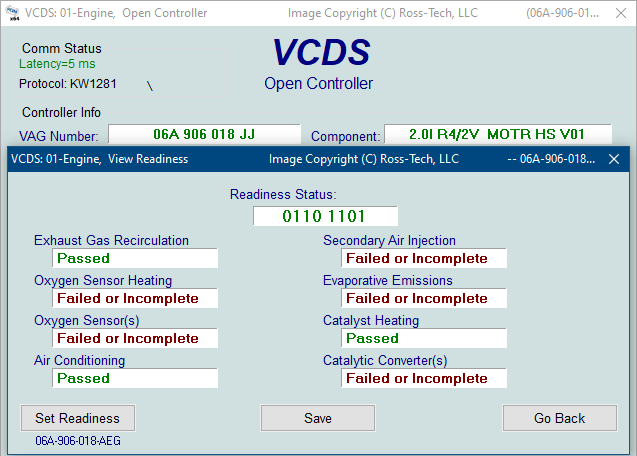
The Readiness test is essentially a group of eight (8) electronic monitors (circuits)  that oversees the correct functioning of various emission related components fitted into all modern day cars.  Each of these operational test needs to be within the legislated specification. When there is a problem with any one monitor, it will set a binary "1" in the readiness code. If there is no problem or it passes a test, it would set a binary "0" in the readiness code. Even though emission monitoring  was the imputus for OBD-II, it wasn't limited to emission monitoring. Since a computer ECU (electronic Control Unit) was needed to  oversee the emission monitors, it was expedient to put it to other uses as well, like engine management. 

As such, the electronic control unit (ECU) was renamed Engine Control Unit (ECU). The computing power of the ECU was underutilized, since its cost certainly wasn't justified by the 8 menial tasks of emission monitoring, so manufactures started adding bells and whistles and other creature comforts. The ECU increased from a 38 pin version to and 80 pin version in a matter of years. The ECU can store information and has a non-volatile memory where it stores the DTC (Diagnostic Trouble Codes) whenever it detects a problem. The ECU also has another  memory where it stores maps of the driver's driving peculiarities which is erased when the battery is disconnected. The driver is also alerted when there is a problem by one or more instrument panel lights that turn on, or start to blink. When this happens a trouble code is stored which can assist the mechanic in solving the problem.

The bells and whistles were so many that their control needed to be grouped and separated and the rest of the control modules were introduced. Hence ECU (Engine Control Module, TCM (Transmission Contol Module), ABS (Antilock Braking System) module combined with  EDL (Electronic Differential Lock), ASR (Anti Slip Regulation) and  EDL (Electronic Differential Lock), Central Electronics Module, Airbags Module, CAN Gateway Module, Instrument Module, Central Convenience Module, Seat Memory Module, Xenon  Module, Auto HVAC Module, Interior Monitor Module, etc... 

These modules are also distributed throughout the car, sometimes placed in the most obscure places with very limited access; and all these modules are also networked (interconnected) on a bus system  called CAN Bus. Individual modules have also been given some sort of intelligence (protocol) so that they can interface with diagnostic equipment. To simplify,  it can be compared to  a land line telephone extension that can communicate with the switchboard using internal control codes. Each module has its "own telephone number" with the gateway module acting as the switchboard and when a diagnostic device is connected, it can communicate with the requested module via the gateway exchange. 

Having this glut of electronic modules on-board means a glut of sensors and a glut of actuators that accompany them; amongst which are the Engine Crank or Cam Position/Speed sensor, Intake Air Temperature (IAT) sensor, the Throttle position, the Coolant Temperature (CLT) Sensor, the Throttle Valve Control Motor, the cooling fan motor (actuator), the Fuel Pressure Regulator (actuator), the Injectors (actuator), the ignition coil (actuator) and the Oxygen Sensor (O2S) (actuator), to mention but a few. 

With all these extra electronics devices that can go faulty or rather will go faulty at some time or the other,  they will need to be repaired;  and since circuit board level repairs are done at a fairly high level, beyond the abilities of average auto technician, hobbyist mechanical or DIY car owner, module replacement is the only option. In order  to determine which component has gone faulty and which module is responsible for controlling it,  without some sort of diagnostic device is near to impossible. 

So as part of the OBD-II standard, was that vehicle manufactures were obliged to install a diagnostic port in the drivers cockpit area for such diagnostic equipment to interface with the Gateway Module. This port is called the DLC (Data Link Connector). And that's were the VCDS cable plugs into. The VCDS software allows you select your vehicle from a list of VAG vehicles then gives you an option the autoscan. The scan below  is a sample of what can be expected, except that if there is a problem with the vehicle, it will be highlighted in red. Were you see  'No fault code found' is where the fault codes will be listed. The P codes can then be analysed / interpreted and the necessary repairs can be carried out.


SAMPLE SCAN

Chassis Type: 9N (9N - VW Polo (2002 > 2010))
Scan: 01 02 03 08 09 15 17 19 25 37 44 45 46 56 76

VIN: AAVZZZ9NZ8U0XXXXX   Mileage: 221080km/137372miles
-------------------------------------------------------------------------------
Address 01: Engine        Labels: None
   Part No SW: 03C 906 057 AK    HW: 03C 906 057 M
   Component: BOSCH ME7.5.20      0707
   Revision: 21H01---    Serial number: VWZ7Z0G555XXX
   Coding: 0000075
   Shop #: WSC 31414 000 00000
 
No fault code found.
Readiness: 0000 0000
-------------------------------------------------------------------------------
Address 02: Auto Trans        Labels: 09G-927-750.lbl
   Part No SW: 09G 927 750 GH    HW: 09G 927 750 GH
   Component: AQ 250 6F           0930
   Revision: 00H67000    Serial number:            
   Coding: 0000072
 
No fault code found.
-------------------------------------------------------------------------------
Address 03: ABS Brakes        Labels: 6R0-907-37x-ABS80.lbl
   Part No SW: 6Q0 907 379 AF    HW: 6Q0 907 379 AF
   Component: ABS 8.0 front   H05 0002
   Revision: 00000000    Serial number: 00000000000000
   Coding: 0002292
 
No fault code found.
-------------------------------------------------------------------------------
Address 08: Auto HVAC        Labels: 6Q0-820-045.lbl
   Part No: 6Q0 820 045
   Component: Klimaanlage        X0850
 
No fault code found.
-------------------------------------------------------------------------------
Address 09: Cent. Elect.        Labels: 6Qx-937-049-C.lbl
   Part No: 6Q0 937 049 F
   Component: 0009 BN-SG.         2S36
   Coding: 17550
   Shop #: WSC 31414

No fault code found.
-------------------------------------------------------------------------------
Address 15: Airbags        Labels: 6Q0-909-605-VW5.lbl
   Part No: 6Q0 909 601 F
   Component: 05 AIRBAG VW5       0010
   Coding: 12341
   Shop #: WSC 31414

No fault code found.
-------------------------------------------------------------------------------
Address 17: Instruments        Labels: 6Q0-920-xxx-17.lbl
   Part No: 6Q0 920 825 P
   Component: KOMBIINSTRUMENT VDO V06
   Coding: 00141
   Shop #: WSC 31550

No fault code found.
-------------------------------------------------------------------------------
Address 19: CAN Gateway        Labels: 6N0-909-901-19.lbl
   Part No: 6N0 909 901
   Component: 01K1 GATEWAY CAN    2S36
   Coding: 00015
   Shop #: WSC 31414
 
No fault code found.
-------------------------------------------------------------------------------
Address 25: Immobilizer        Labels: 5J0-920-xxx-25.clb
   Part No: 6Q0 920 825 P
   Component: IMMOBILIZER VDO V06
   Coding: 00141
   Shop #: WSC 31550
 
No fault code found.
-------------------------------------------------------------------------------
Address 44: Steering Assist        Labels: 6Q0-423-156.clb
   Part No: 6Q0 423 156 AB
   Component: LenkhilfeTRW        V270
   Coding: 10110
   Shop #: WSC 31414
 
No fault code found.
-------------------------------------------------------------------------------
Address 45: Inter. Monitor        Labels: 6Q0-951-171.lbl
   Part No: 6Q0 951 171 C
   Component: Innenraumueberw.    0020
 
No fault code found.
-------------------------------------------------------------------------------
Address 46: Central Conv.        Labels: 6Q0-959-433.lbl
   Part No: 6Q0 959 433 E
   Component: 67 Komfortgerát     0002
   Coding: 00018
   Shop #: WSC 31414

No fault code found.

End   ---------------------------------------------------------------------


VCDS

VCDS stands for "VAG-COM Diagnostic System" and it is a dongle based hardware cable sold by Ross-tech governed by intellectual property rights. It pairs with Ross-tech's freely downloadable and regularly updated Windows based computer program that interrogate your vehicles on-board modules. However, the software needs to be registered on-line in order to take benefit from the regular upgrades.  This software provides a GUI with menus to scan the vehicle, that allows you to view Fault Codes, Measuring Blocks and view VAG-Scope data. It also permits you to clear any Fault Codes, and recode a module after  replacing it, log Data to a CSV file,  perform Basic Settings and Output Tests. And so much more. It is probably the most versatile tool to tackle any Volkswagen, Audi, Seat or Skoda repairs. Any auto workshop specializing in VW vehicles that doesn't have VCDS is at a loss, even if  they have a Launch X431, or TOAD, or Autoboss V30, the MaxiDAS DS708, etc. VCDS is specific to VAG vehicles and personally I'm very impressed with  its functionality, and I tip my hat to the Ross-Tech team.  

However, the "high price" of their cable has permitted several competitors to compete with them, producing a clone cable that works with Ross-Tech software. I'm not saying that the price of the cable doesn't justify its capabilities but if the price was more manageable for non-USA based VW owners, virtually every VW, Audi, Skoda, Seat owner would feel obliged to invest in said cable; and at the same time Ross-Tech will get rid of all the clone shysters. the same cable and software works admirably of Bugatti, Lamborghini, Bentley, Porsche and for them price is not an issue. Being a US based company Ross-Tech wants payment in USD but the USD to ZAR is  currently sitting at 1:14 and I'm certain most VAG car owners paying in another currency that don't convert favorably with the USD may have similar reservations. Enough said, go get that cable!  
________________________________________________________________________

VCDS for Volkswagen, VCDS for VW, VCDS for Polo, VCDS for Jetta, VCDS, for Golf, VCDS for Passat, VCDS for Audi, VCDS for Bentley, VCDS for Bugatti, VCDS for Bugatti Chiron, VCDS for Bugatti Veyron, VCDS for Royale, VCDS for Bugatti Garros, VCDS for Lamborghini, VCDS for Gallardo,  VCDS for Aventador, VCDS for Huracan, VCDS for Porsche, VCDS for Porsche Cayman, VCDS for Porsche Boxster, VCDS for Porsche Panamera, VCDS for Porsche Cayenne, VCDS for Porsche Macan, VCDS for 2013 Porsche 911,VCDS for SEAT, VCDS for Škoda, VCDS for Caddy, VCDS for Amarok, VCDS for Fox, VCDS for Lavida, VCDS for Beetle, VCDS for Routan, VCDS for Scirocco, VCDS for Up, VCDS for Vento, TVCDS for Tiguan, VCDS for Taureg,

Friday, March 4, 2016

AUTEL D900 SCAN TOOL

AUTEL D900 SCAN TOOL

The modern day car in its current incarnation has increasingly become more and more electrotechnical than mechanical and technological advancements are constantly on the incline.  It is therefore  quite appropriate to say that vehicle owners need to become electromechanical savvy. In my opinion, the way forward is to invest in a scan tool for your particular make and model car. Since most people are familiar with Cell Phones, Decoders, Set Top Boxes, PVR, DVR and Televisions with various menus, or computers, access points and routers  with various wizards, navigating a scan tool would be relatively easy. A scan tool is an indispensable device for modern car diagnostics and is a technological marvel that's going to save you time and money, but only if you are willing to embrace the technology. 


In a previous blog I discussed VCDS which I think is a really fantastic piece of software with its hardware interface combination specific to VAG vehicles. The amount of Onboard information that is accessible with VCDS is astounding and it is literally beter than the factory  VAS Scan Tool used by VW /AUDI /SKODA / SEAT agents. In fact, in some cases VCDS  will even retrieve more faults than the VAS tools.  Be that as it may, as fantastic as VCDS is, it has major shortcomings for vehicle owners in general. Since VCDS is VAG specific, all other vehicle owners are at a loss to its technical capabilities and would have to look at other scan tools from  companies like  Auto Boss, Launch X431, Autel Maxidas DS708, Pro-Link iQ,  Mentor Touch ET6500, OTC Pegisys, Craftsman - 20899, G-Scan Oceania, Bosch 3824, etc, who produce commercial multivehicle scan tools. These companies cater for the automotive service industry since their scan tools are quite pricey and far beyond the budget of the average car owner.  If VCDS was multivehicle, it would be as good if not better than most commercial scan tools. However, since this is not the case,  Autel has come to their aid of the average car owner. Autel has a low cost handheld scan tool that is multivehicle compatible that supports the following list of vehicles.

Acura, Audi, BMW, Buick, Cadillac, Chevrolet, Chrysler, Daewoo, Dodge, Eagle, Ford, Geo, GMC, Honda, Hummer, Hyundai, Infiniti, Isuzu, Jaguar, Jeep, Kia, Land Rover, Lexus, Lincoln, Mazda, Mercedes Benz, Mercury, Mitsubishi, Nissan, Oldsmobile, Pontiac, Porsche, Plymouth, Saab, Saturn, Scion, Suzuki, Toyota, Volkswagen, Volvo.  

I acquired the 2015 version because of its versatility because it supports several models of each of the above mentioned vehicles. I wanted it to diagnose my Renault but discovered that it unfortunately does't support Renault and even more surprisingly it doesn't support my  VW Polo  2.0L Highline (9N) either but it does support the the following list of VAG vehicles.

Audi A3
Audi A4
Audi A6
Audi A8
Audi A8L
Audi All road
Audi Cabriolet
Audi S4
Audi S6
Audi S8
Audi TT

Volkswagen Beetle
Volkswagen Bora
Volkswagen Eurovan L5
Volkswagen Eurovan VR6
Volkswagen Golf A3
Volkswagen Golf A4
Volkswagen GTI
Volkswagen Jetta A3
Volkswagen Jetta A4
Volkswagen Passat
Volkswagen Touareg

I don't know if the previous years version (Autel D900 2012) supports older vehicles like 2002-2010, but am of the opinion that all newer scan tools are backward compatible though I may be wrong. Anyway, the Autel scan tool is really cool, it comes with a mini CD containing a pdf file of all supported vehicles. I would have thought they would include a list of generic DTCs for Chassis / Powertrain (P-codes), Body (B-codes)  and Network (U-codes) for easy of identification. What this implies is that you will have to either find these lists online, save them as pdfs or print them or access the internet resources to identify the codes every time you car throws you a DTC.

CONTINUED

Thursday, March 5, 2015

INTERMITTENT IMPLAUSIBLE


VW POLO 9N HIGHLINE


The VW Polo comes in three flavours viz. the 9N1, 9N2 and the 9N3, dating from 2002-2009.  The Skoda Fabia and the Seat Ibiza/Cordoba share many of the 9N trates but omit Address 25 since all their onboard control module functions are not identical. In the case of the VW Polo, it shares the coding in Address 17 with Address 25 because they are linked, but this applies morso to the 9N3. However, the easiest way to recognised the 9N and its clones, are by the 6Q0, 6Q1, 6L0, 6N0 and 6R0 modules which are also populated in the Polo 6N range. The interesting thing is that even though some module are the same in both its hardware and software, they have different codings specified. 

It is understandable, since the coding value is subject to the collective components fitted because the coding is a sum of the binary value applicable to the individual components. This can be seen in the three scans below. Be that as it may, module coding seems to be a huge problem with most vehicle owners who do their own repairs, however I have also seen qualified mechanicians struggle for days to get a car back to its readiness state. The status chart below is what every VAG driver / owner desires from their vehicle, but  is often totally elusive.

01-Engine -- Status: OK 0000
03-ABS Brakes -- Status: OK 0000
08-Auto HVAC -- Status: OK 0000
09-Cent. Elect. -- Status: OK 0000
15-Airbags -- Status: OK 0000
17-Instruments -- Status: Status: OK 0000
19-CAN Gateway -- Status: Status: OK 0000
25-Immobilizer -- Status: OK 0000
44-Steering Assist -- Status: OK 0000
46-Central Conv. -- Status: OK 0000
56-Radio -- Status: OK 0000

Readiness: 0 0 0 0 0  / Gata de funcþie: 0 0 0 0 0 / Tests passés: 0 0 0 0 0

VCDS FAILED READINESS SETTING
What I have found, is that when a component that contributes to the module coding value malfunctions, the scan reads "1 Fault Found: 01044 - Control Module Incorrectly Coded" but if the malfunctioning component is first repaired or replaced, and the fault is cleared, the  01044 code does not return since the checksum of the module is once again correct. Many vehicles owners see this 01044 code and start changing module codes, normally just to see what happens. But, and a big but at that, before I continue, I need to stress that it's imperative to print out a scan of the faults and the module codings before any repairs are attempted, so that, if there is a problem, you can always revert back to the original coding. Failure to so could incapacitate your car until it can be correctly re-coded which could be both time consuming and expensive. Implausible and Intermittent (implausible  intermittent signal) problems on VAG cars are rife or rather intermittent and implausible  (implausible  intermittent signal)  problems on all cars are rife ever since control modules were introduced. The main reason for this is bad, poor or intermittent electrical contact, especially  considering the vast increased in the number of multi-pin plugs and sockets and edge connectors. Because vehicles move,  the  forces on the electrical connections constantly changes and that's besides the expansions caused by heat and the contractions caused by cold, and the corrosive effect of the weather on vehicles. Hence intermittent problems in all languages abound. What follows is just a sampling of the intermittent and implausible (implausible  intermittent signal) error codes we could encounter.

01314 - Engine Control Module
013 - Check DTC Memory - Intermittent

00816 - Sensor für Lenkhilfe
30-00 - Unterbrechung / Kurzschluß nach Plus

00716 - Air recirculation Flap Positioning Motor (V113)
000 -  -  - Intermittent

01336 - Bus de données Groupe Confort
80-00 - en mode fil unique

004506 - Fuel Pressure Sensor (G247)
P119A - 000 - Malfunction - Intermittent - MIL ON

01596 - Servomoteur de volet d´air frais/air recyclé (V154)
30-10 - Rupture/court-circuit au pôle + - Intermittent

01336 - Data Bus for Comfort System
80-10 - Single-Wire Operation - Intermittent

01271 - Stellmotor für Temperaturklappe (V68)
000 - - - Sporadisch

00588 - Airbag Igniter; Driver Side (N95)
32-10 - Resistance too High - Intermittent

00778 - Steering Angle Sensor (G85)
49-10 - No Communications - Intermittent

00706 - Relais de ventilateur de radiateur V7 et V35 -vitesse 2 (J513)
009 - Rupture/court-circuit à la masse - Intermittent

00896 - Closing unit tailgate (F256)
27-10 - Implausible Signal - Intermittent (implausible  intermittent signal) ----------

00576 - Klemme 15
002 - unterer Grenzwert unterschritten - Sporadisch

01312 - Powertrain Data Bus
37-10 - Faulty - Intermittent

00-Senzor unghi volan -- Status: OK 0000
01-Motor -- Status: Malfuncþie 0010
03-ABS frâne -- Status: OK 0000
08-Clima automatã -- Status: OK 0000
09-Electronica centralã -- Status: Malfuncþie 0010
15-Airbaguri -- Status: OK 0000
16-Electronicã volan -- Status: OK 0000
17-Instrumente bord -- Status: OK 0000
19-Poarta CAN  -- Status: Malfuncþie 0010
25-Blocare pornire -- Status: OK 0000
42-Uºa electr. ºofer -- Status: OK 0000
44-Asistenþã direcþie -- Status: OK 0000
46-Confort -- Status: Malfuncþie 0010
52-Uºa electr.pasager -- Status: Malfuncþie 0010
56-Radio -- Status: OK 0000
69-Tractare -- Status: Neautorizat 0001
76-Asistenþã parcare -- Status: OK 0000
7D-Încãlz. Aux. -- Status: Malfuncþie 0010

VW JETTA WIRING HARNESS
However,  we all desire the following messages from our cars:-  Aucun code défaut trouvé. No fault code found. Kein(e) Fehlercode(s) gefunden. Nu a gãsit coduri.  The wiring harness of all cars are made with flexible multicore wire with terminal connectors and clip-lock plugs to facilitate connection durability when driving on bumpy roads and uneven surfaces but it seems that shaking, vibration, heat, shafting and corrosion are responsible for the above errors which would probably not resulted if there were not as many interconnected sub harnesses, and multi-pin electrical connections. Volkswagen  vehicles wiring harnesses have undergone a huge technological evolution since 1984. So much so that  30 years later the average wiring harnesses has become extremely complex because the number of terminals have progressively increased from a typical 200 terminals in a 1994 vehicle to as many as 1,400 terminals in the latest models.

The cost implications of these new wiring harnesses and electronic modules constitute more than a quarter of the price of the cars. It is estimated that it takes approximately one and a quarter hours to completely assemble and engine on a production line, whereas it takes more than 5 hours to assemble a wiring harness. Since the complexity of wiring harnesses  escalated exponentially, it is only obvious that the time and cost associated with repairing wiring harness would increase considerably. Thinner wires are used carrying extremely low-level signals and data, interlinked electronic control modules, sensors and actuators communicating in several protocols, collectively resulting in limited access and mass confusion. Restated, automotive repairs have become lot more complicated and it is estimated that almost half of all warranty repairs are caused by electrical malfunctions, and approximately 30 percent of all tow-ins, are due to problems associated with the wiring harness.

This emphatically tells us that the wiring harness is no longer a collection of wires and connectors bound together, because each and every length of wire, connection,  twist and turn, is carefully engineered to suit the application and its environment. Therefore whenever electrical harness repairs become necessary, don't use shortcuts and offcuts pieces of wire from an old extension lead or solid wire from domestic electrical cable and solder joints. Solder joints will eventually break due to vibration and spirited driving. Use the appropriate motor grade multicore flexible wiring of the appropriate diameter with the correct terminals and the appropriate electronic modules and components to restore the wiring harness to its original integrity because failure to do so, will only result in more intermittent and implausible (implausible  intermittent signal) contacts. To give you some idea of the wiring harness complexity I have included the numbers of the various sub harnesses that constitute the entire harness for my car.

WIRING HARNESS

VW Polo Highline 2.0L wiring harness  numbers ( Teilenummern ZSB- Leitungsstrang)

6Q2 970 005 DH, 6Q2 970 006 Q, 6Q2 970 010 L,  6Q2 970 024 H,
6Q2 970 076 AB, 6Q2 970 091 H, 6Q2 970 099 E , 6Q2 970 106 RB,
6Q2 970 111 D,   6Q2 970 154 C, 6Q2 970 191 D,  6Q2 970 083 CJ,
6Q2 970 050 P,    6Q2 970 125 K, 6Q2 970 102 RQ,  6Q2 970 023 CD,
6Q2 970 003 L,    6Q2 970 049 F, 6Q2 970 000 RQ,   6Q2970 030 AA
6Q2970 012 CN,

The underlined 6Q2 970 049 F above is the Cent. Elect. Controller 0009 BN-SG.   2S36 siting at Address 09,  the rest are individual harnesses or rather interconnecting parts of a whole harness.

SCANS

Chassis Type: 9N1 - VW Polo
Scan: 01,02,03,08,09,15,17,19,37,44,46,56,69

Address 01 -------------------------------------------------------
Controller: 032 906 032 E
Component: ME7.5.10 *2503
Coding: 00071

Address 03 -------------------------------------------------------
Controller: 6Q0 907 379 AF
Component: ABS 8.0 front H03 0002
Coding: 0002175

Address 08 -------------------------------------------------------
Controller: 6Q0 820 045
Component: Klimaanlage X0840

Address 09 -------------------------------------------------------
Controller: 6Q0 937 049 D
Component: À0_0 BN-SG. 1S34
Coding: 25742

Address 15: ------------------------------------------------------
Airbags
Controller: 6Q0 909 605 AE
Component: 0H AIRBAG VW5 0C 0010
Coding: 12360

Address 17 -------------------------------------------------------
Controller: 6Q0 920 823 B
Component: KOMBI+WEGFAHRSP VDO V02
Coding: 00141

Address 19 -------------------------------------------------------
Controller: 6N0 909 901
Component: 0000 GATEWAY CAN 1S34
Coding: 00014

Address 44 -------------------------------------------------------
Controller: 6Q0 423 156 AB
Component: LenkhilfeTRW V270
Coding: 10140

Address 46 -------------------------------------------------------
Controller: 6Q0 959 433 E
Component: 67 Komfortgerát 0002
Coding: 00018

Address 56 -------------------------------------------------------
Controller: 6Q0 035 186 A
Component: Radio FF6 0001
Coding: 00401

End -------------------------------------------------------


Fahrzeugtyp: 9N - VW Polo
Scan: 01 02 03 08 09 15 17 19 25 37 44 45 46 56 76

Adresse 01: -------------------------------------------------------
   Motor
   Teilenummer: 03D 906 023
   Bauteil: SIMOS91 1.2l 2V     5415
   Revision: --H04---    Seriennummer: VWZ5Z0G8041219
   Codierung: 0000071
   Betriebsnr.: WSC 00810 219 84798
 
Adresse 03: -------------------------------------------------------
   Bremsen  
   Teilenummer SW: 6Q0 907 379 AF    HW: 6Q0 907 379 AF
   Bauteil: ABS 8.0 front   H05 0002
   Revision: 00000000    Seriennummer: 00000000000000
   Codierung: 0002082
   Betriebsnr.: WSC 00788 785 00200

Adresse 08: -------------------------------------------------------
   Klima/Heizung  
   Teilenummer: 6Q0 820 045
   Bauteil: Klimaanlage        X0850

Adresse 09: -------------------------------------------------------
   Bordnetz      
   Teilenummer: 6Q1 937 049 F
   Bauteil: 0009 BN-SG.         2S36
   Codierung: 25742
   Betriebsnr.: WSC 00788
 
Adresse 15:  -------------------------------------------------------
   Airbag      
   Teilenummer: 1C0 909 605 K
   Bauteil: 19 AIRBAG VW51 0P   0010
   Codierung: 12601
   Betriebsnr.: WSC 00788
 
Adresse 17: -------------------------------------------------------
   Kombiinstrument    
   Teilenummer: 6Q0 920 804
   Bauteil: KOMBIINSTRUMENT AGD V04
   Codierung: 01131
   Betriebsnr.: WSC 00000
 
Adresse 19: -------------------------------------------------------
   CAN-Gateway      
   Teilenummer: 6N0 909 901
   Bauteil: 01K1 GATEWAY CAN    2S36
   Codierung: 00014
   Betriebsnr.: WSC 00788
 
Adresse 25: -------------------------------------------------------
   Wegfahrsperre
   Teilenummer: 6Q0 920 804
   Bauteil: IMMOBILIZER     AGD V04
   Codierung: 01131
   Betriebsnr.: WSC 00000
 
Adresse 44: -------------------------------------------------------
   Lenkhilfe    
   Teilenummer: 6Q0 423 156 AB
   Bauteil: LenkhilfeTRW        V270
   Codierung: 10140
   Betriebsnr.: WSC 00788
 
Adresse 46: -------------------------------------------------------
   Komfortsystem    
   Teilenummer: 6Q0 959 433 E
   Bauteil: 3F Komfortgerát     0002
   Codierung: 00019
   Betriebsnr.: WSC 00788
 
Adresse 56: -------------------------------------------------------
   Radio      
   Teilenummer SW: 6Q0 035 152 G    HW: 6Q0 035 152 G
   Bauteil: Radio DE2           0007
   Revision: 00005000    Seriennummer: VWZ4Z4G3272350
   Codierung: 0020200
   Betriebsnr.: WSC 00788 785 00200
 
Ende -------------------------------------------------------

Type chassis: VW Polo 9N
Scanner: 01 02 03 08 09 15 17 19 37 44 45 46 56 76

Adresse 01: -------------------------------------------------------
Moteur
No. pièce: 038 906 019 NC
Pièce: 1,9l R4 EDC 0000SG 6138
Codage: 00002

Adresse 03: -------------------------------------------------------
Freins ABS
No. pièce Log: 6Q0 907 379 AF Mat: 6Q0 907 379 AF
Pièce: ABS 8.0 front H05 0002
Révision: 00000000 No. de série: 00000000000000
Codage: 0002193

Adresse 08: -------------------------------------------------------
Climatronic
No. pièce: 6Q0 907 044 E
Pièce: CLIMAtronic PQ24 3805

Adresse 09: -------------------------------------------------------
Centrale Elec.
No. pièce: 6Q1 937 049 F
Pièce: 0009 BN-SG. 2S36
Codage: 09870

Adresse 15: -------------------------------------------------------
Airbags
No. pièce: 1C0 909 605 K
Pièce: 17 AIRBAG VW51 0N 0010
Codage: 12599

Adresse 17: -------------------------------------------------------
Instruments
No. pièce: 6Q0 920 825 H
Pièce: KOMBIINSTRUMENT VDO V06
Codage: 01141

Adresse 19: -------------------------------------------------------
Gateway CAN
No. pièce: 6N0 909 901
Pièce: 01K1 GATEWAY CAN 2S36
Codage: 00014

Adresse 44: -------------------------------------------------------
Direction assistée
No. pièce: 6R0 423 156
Pièce: LenkhilfeTRW V272
Codage: 10120

Adresse 46: -------------------------------------------------------
Module confort
No. pièce: 6Q0 959 433 E
Pièce: 5F Komfortgerát 0002
Codage: 00017

Adresse 56: -------------------------------------------------------
Radio
No. pièce Log: 6Q0 035 152 E Mat: 6Q0 035 152 E
Pièce: Radio 9NK 0004
Révision: 00001000 No. de série: VWZ4Z4H0100621
Codage: 0040400

End -------------------------------------------------------

Feel free to upload your VW, SKODA, SEAT & AUDI scans.

Adresse, Address,  Betriebsnummer, WS Code, Control Module for Airbags, Control Module for Climatronic, Control Module in Instrument Cluster, Power Steering Control Module, Engine Control Module, Data Bus for Comfort System, Coding, Control Module for Digital Sound Package, No Signal/Communication - Intermittent, Intermittent Operation, Defective - Intermittent, Open Circuit — Intermittent, Short to Ground — Intermittent, Open or Short to Plus — Intermittent, Implausible Signal — Intermittent, No Communications - Intermittent, Electrical Fault in Circuit - Intermittent,

Saturday, April 20, 2013

VW ERROR CODES


VOLKSWAGEN ERROR CODES

My VW Polo Classic 2.0L Highline has been acting-up  more and more as the date for  her 90 000Km  service approached.   The Volkswagen Auto suddenly became very heavy on fuel and she started to smoke. It wasn't grey smoke, which would imply the VW Polo was burning oil but rather black smoke which is the tell tale sign that the VW Polo is burning gasoline. I normally do about 6 liters per 100kms but with the last tank of fuel I got something like 9 litres per 100km. With the latest high price of fuel in South Africa, I just had to investigate.  The EPC light problem also returned, which was triggered by the ECU that  placed the Polo into "Limp Mode" once again.  


Rusty water residue still on the engine cover above the VW logo.
However that's not all. My VW  Polo's interior overhead lights above the rear view mirror and sun visor courtesy lights have all stopped working when I open the doors but works perfectly when switched on manually. The  hooter also just gave up the ghost, but  the click of the micro switch in the steering wheel is very audible when I press it.  One of my VW headlight also seems to be intermittent and it appears that my oil level sensor also does'nt work either. My VW air conditioner stopped working  and my VW left tail bulb fused again and the reverse light is intermittent. I was told that it goes on or flickers whilst I'm driving.   But worst of all my VW Polo overheated whilst driving in peak hour traffic and the fans didn't even come on. When I pulled the bonnet release, the little lead ball at the end of the cable snapped off. Consolation I noticed the steam coming out from under the bonnet before the heat gauge was at 100 degrees. To add insult to injury, normally at approx 20 kph all the doors of VW das auto locks, but lately the front passenger side door unlocks itself mere seconds after it locks. This is a security risk and with all the other problems I've been experiencing, I just had to connect the VW to a diagnostic tester. This turned out to be a weekend job when the following Error Codes popped up.

Chassis Type: 9N3 - VW Polo
Scan: 01,02,03,08,09,15,17,19,37,44,46,56,69

Address 01 -------------------------------------
Controller: 06A 906 032 PB
Component: 2.0l ME7.5.10 0305
Coding: 00071
Shop #: WSC 01120
VIN: AAV ZZZ 9NZ 7Uxxxxxx  / VWZ7Z0G5248478
Readiness: 0000 0000

SOME ERROR CODES:-

VW, Polo Highline, Polo 1.9 TDi, Volkswagen beetles, Jetta, VW Polo cross, Passat, Polo GTi, Bora, Volkswagen bluemotion, Polo Classic,   Polo 1.9 tdi,  VW Polo blue motion,  Cross Polo, VW Golf, Beetle, Audi, VW blue motion,  Skoda, VW Touran, VW Touareg,  VW Tiguan, VW Amrok, VW Rabbit, VW Caddy, VW Phaeton, VW Vento, VW Kombi, VW Transporter, VW Lupo and VW Vivo - Error Codes

VW Error code 16716  P0332 - Knock Sensor 2 (G66): Signal too Low - Intermittent 
VW Error code 17511  P1103 - Oxygen (Lambda) Sensor Heating: B1 S1: Performance too Low
VW Error code 17796  P1388 - Control Module Malfunction - DBW Throttle Monitoring 
VW Error code 18010  P1602 - Power Supply (B+) terminal 30 Low Voltage
VW Error code 18041  P1633 - Accelerator Position Sensor 2 (G185): Signal too Low
VW Error code 18047  P1639 - Accelerator Position Sensor 1/2 (G79/G185): Implausible Signal
VW Error code 18048  P1640 - Internal Control Module: EEPROM Error
VW Error code 18090  P1682 - Powertrain Data Bus: Implausible Message from ABS Controller
VW Error code 18104  P1696 - Powertrain Data Bus: Implausible Message from Steering Column Controller


Turns our that ECU CAN bus edge connectors were corroded which solved P0332, P1682, and P1689The P1602 is not really considered an error since it will always be present in the ECU if or when the Battery was disconnected. P1388, P1633 and P1639 are related to accelerator pedal sensors and once the pedal is replaced that problem will be solved, other than that, the VW Polo drives perfectly normal. The Internal Control Module, error P1640 however is going to take a bit longer to solve since it appears that several of my VW module's coding values has somehow changed on their own. But most of all I'm glad I solved the black smoke problem. I found that the wire of  the Oxygen sensor was burnt onto the exhaust pipe and shorted out the sensor. So I'm back to 6 litres per 100Km.

Radiator relay controller destined to be replaced since neither of the fans operate.

There were no errors on the ECU for the overheating radiator  and when I removed the bonnet release cable I saw that the bonnet open sensor / switch wire was broken off. I traced the heating problem to the  relay (picture above) and while I was under the engine I noticed that the Air Conditioner compressor wires had frayed and were dangling loose.

Before and after - Air Conditioner Compressor wires frayed and somehow broke off 
Before and after - Bonnet open/close micro-switch/sensor  with wires reattached.
Oil level sensor wires hardened and became brittle resulting in no electrical connection
 I cut off the hardened pieces of wire, tinned them with solder and reconnected the wires to the oil sensor with electrical block connectors since the terminals initially used by VW didn't seem to last very long. The block connector appears to makes a much better connection.

The plastic insulators on the spade terminal couldn't withstand the heat of the cool blue bulbs.
VW VAG - Volkswagen error codes and VW Electronic Module diagnostics will be dealt with in subsequent blogs, starting with Engine Modules for the Polo 9N , then ABS Modules then Airbag Modules.